Fourier GR2 Review (4★)
Fourier Intelligence · Humanoid
Editorial
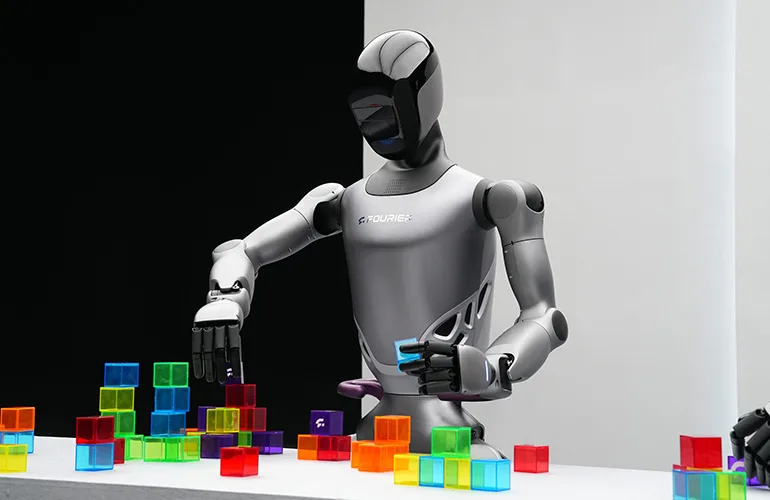
Fourier GR2 is the dark horse of the humanoid market — less hyped than Figure or Optimus, but with the best force-control architecture of any robot in its price class. The 40-DoF dual-arm system with 8-DoF dexterous hands is unmatched for bimanual manipulation tasks, and the 0.1N torque resolution enables true compliant control that makes the robot safe to operate alongside humans without cages. The open SDK is a breath of fresh air in a market dominated by closed ecosystems — researchers and integrators can actually build on this platform. The weakness is deployment maturity: while Fourier has pilots in rehab and light assembly, there's no BMW Spartanburg or GXO Logistics-scale deployment to point to. The 2-hour battery and slow walking speed also constrain it to stationary or near-stationary work cells. For research labs and early-stage commercial pilots needing dexterous dual-arm manipulation with an open SDK, GR2 is the best value proposition available.
What this assessment is based on
Published manufacturer specifications, deployment reports, and operator accounts. ZeroGantry does not claim hands-on testing of this unit unless stated. Scores are editorial judgments from those public sources — see the methodology for how labels are assigned.
Published 2026-06-08
Pros
- 40-DoF dual-arm system with 8-DoF dexterous hands — highest DoF count in any commercially available humanoid under $200k
- Force-controlled joint modules provide 0.1N torque resolution for compliant, safe human-robot interaction
- Dual-armed coordinated manipulation enables bimanual assembly tasks that single-arm humanoids cannot perform
- Open SDK with ROS2 and Python bindings — most developer-accessible humanoid platform on the market
Cons
- 2-hour battery life limits real shift-length deployment without hot-swap logistics
- 1.5 m/s walking speed is the slowest in the humanoid class — not suited for large-warehouse workflows
- Limited public deployment data — primarily in research and pilot settings, no large-scale production benchmarks
- Fourier's smaller scale vs Tesla/Figure creates supply-chain risk for spare parts and long-term support
Fourier GR2 specifications
| Degrees of freedom | 40 |
|---|---|
| Weight | 58 kg |
| Battery life | 3 h |
| Payload | 15 kg |
| Max speed | 1.5 m/s |
| Actuators | FSA (Force-Adaptive Servo Actuators) |
| Primary sensor | Depth Camera + IMU Fusion Array |
| Function | Research & development |
| Released | 2023 |
| Maturity | Advanced |
| Status | Active |
| Indicative price | $100,000 |
Fourier GR2 service and repair
ZeroGantry tracks robot repair and service providers across the United States by state, brand, and robot type.
- Robot repair directory — providers by state, brand, and robot type
Other robot reviews
- HUBO-2 Plus review — Rainbow Robotics
- XPeng IRON (Gen 2) review — XPeng
- Reachy review — Pollen Robotics
- Astribot S1 review — Astribot (Stardust Intelligence)
- 1X NEO review — 1X Technologies
- NAO review — Aldebaran / SoftBank Robotics