Atlas (Electric) Review (4★)
Boston Dynamics · Humanoid
Editorial
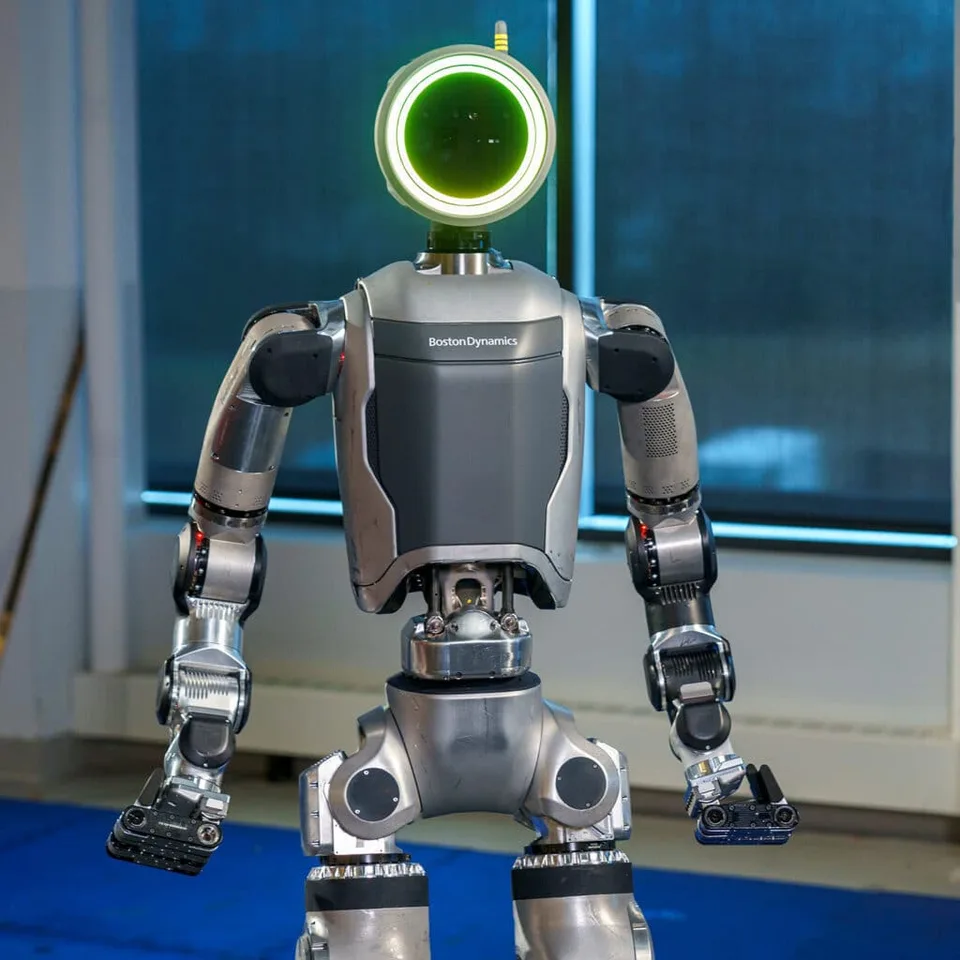
Boston Dynamics' electric Atlas arrives with elite kinematics and payload specs that outclass most 2026 humanoids, yet its 4-hour battery and 90 kg frame expose the trade-offs of prioritizing strength over endurance. Early deployments at Hyundai's RMAC will provide the first hard data on cycle times in automotive lines, but the complete lockup of 2026 production signals supply constraints rather than market readiness. Continuous joints and self-swapping batteries are genuine engineering wins, but absent published reliability figures the robot remains a high-risk bet for anyone outside the Hyundai ecosystem. At this stage Atlas sets the technical ceiling for dexterous humanoids while underscoring how far the industry still is from plug-and-play industrial deployment.
What this assessment is based on
Published manufacturer specifications, deployment reports, and operator accounts. ZeroGantry does not claim hands-on testing of this unit unless stated. Scores are editorial judgments from those public sources — see the methodology for how labels are assigned.
Published 2026-07-08
Pros
- 56 degrees of freedom with continuous 360° rotational joints for unmatched dexterity and reach up to 2.3 m
- 4-hour swappable battery with 3-minute autonomous self-swap enabling near-continuous operation
- 50 kg instant / 30 kg sustained payload capacity with automotive-grade IP67 rating and -20° to 40°C operating range
- First 2026 deployments committed to Hyundai RMAC automotive facility and Google DeepMind for real-world industrial validation
Cons
- Only 4-hour runtime before mandatory battery swap limits untethered shifts without infrastructure
- 90 kg mass and research-phase status restrict broad commercial availability beyond 2026 Hyundai/DeepMind fleets
- No public MTBF or long-term reliability metrics available as production just begins at Boston HQ
- Fully committed 2026 output leaves zero capacity for external customers until 2027 at earliest
Atlas (Electric) specifications
| Availability | Demo — Research platform demonstrated publicly; never offered for sale. (as of 2026-09-05) |
|---|---|
| Degrees of freedom | 28 |
| Weight | 89 kg |
| Battery life | 2 h |
| Payload | 25 kg |
| Max speed | 2.5 m/s |
| Actuators | High-Torque Switched Reluctance Motors |
| Primary sensor | RealSense & Solid-State LiDAR Matrix |
| Function | Research & development |
| Released | 2024 |
| Maturity | Experimental |
| Status | Testing |
| Indicative price | N/A (R&D only) |
Atlas (Electric Humanoid) service and repair
ZeroGantry tracks robot repair and service providers across the United States by state, brand, and robot type.
- Robot repair directory — providers by state, brand, and robot type
Other robot reviews
- Spot review — Boston Dynamics
- HUBO-2 Plus review — Rainbow Robotics
- XPeng IRON (Gen 2) review — XPeng
- Reachy review — Pollen Robotics
- Astribot S1 review — Astribot (Stardust Intelligence)
- 1X NEO review — 1X Technologies