Players · AI-derived
Unitree $6B STAR IPO: First Pure Humanoid A-Share Fleet Play
Unitree Robotics cleared its Shanghai STAR Market IPO in a record 73 days, targeting ¥4.2B raise at ~$6B+ valuation. The filing reveals 2025 shipments exceeding 5,500 humanoids driving 52% of revenue at 60% gross margins, underscoring early unit economics in commercial humanoid scaling. This positions Unitree as the first dedicated humanoid pure-play on China's A-shares amid broader fleet orchestration challenges.
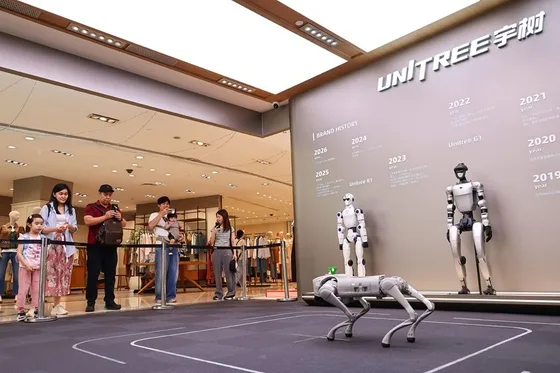
Unitree's Record-Speed STAR Listing and Valuation Dynamics
Unitree Robotics filed its Shanghai STAR Market IPO application on March 20, 2026, securing listing committee approval on June 1 after just 73 days of review—the fastest for a high-tech robotics issuer in recent cycles. The Hangzhou firm targets ¥4.2 billion (~$608–621 million) through issuance of at least 40.45 million shares, representing a minimum 10% post-IPO float. This structure implies a post-money valuation exceeding $6 billion, building on earlier private rounds that valued the company at $1.7 billion in mid-2025.
The prospectus highlights Unitree's shift from quadruped dominance to humanoid leadership. In 2025, the company shipped over 5,500 humanoid units globally, capturing approximately 32% market share by volume. Humanoids accounted for 52% of total revenue, with overall gross margins at 60.27%. These figures point to improving unit economics as production scales, though sustained profitability depends on reducing per-unit BOM costs below current actuator and sensor heavy configurations.
Commercial Fleet Economics and Pilot Audits
Unitree's shipment volume enables initial commercial pilot audits in logistics and light manufacturing. Reported 60% gross margins suggest positive contribution margins once fixed R&D amortization is excluded, yet MTBF data remains undisclosed in public filings. Industry benchmarks for similar legged platforms indicate 2,000–4,000 hour intervals between failures in controlled environments; achieving >8,000 hours will be critical for warehouse ROI models targeting 18–24 month paybacks.
Fleet control orchestration emerges as the next bottleneck. With thousands of units deployed, centralized task allocation, predictive maintenance scheduling, and multi-robot coordination via embodied AI models become essential. Unitree's prospectus allocates IPO proceeds to intelligent robot model R&D and a new manufacturing base, directly addressing these scalability levers. Unit economics improve with volume: at 5,500+ units, average selling prices appear to support 52% revenue contribution while maintaining high margins, but further cost-down on harmonic drive assemblies and torque-dense actuators will determine 2027–2028 fleet expansion viability.
Technical Architecture and Hardware Realities
Architecture Unitree employs reinforcement learning policies layered with model-based control for locomotion and manipulation, transitioning from quadruped foundations to full humanoid embodiments. Embodied AI models handle perception-to-action loops, though full end-to-end diffusion policies remain under development per filing disclosures.
Actuators and Sensors High-performance harmonic drives paired with FOC torque sensors and integrated joint modules form the core actuation stack. LiDAR and multi-camera suites provide environmental mapping, enabling semi-autonomous navigation in structured warehouse settings. These components contribute significantly to BOM costs, directly impacting the observed 60% gross margins.
Limitations Energy density constraints limit continuous operation to 2–4 hours per charge in dynamic tasks. Latency in cloud-orchestrated fleet commands and mechanical fragility under variable loads remain unresolved, constraining true 24/7 warehouse deployment. High per-unit costs currently restrict addressable markets to subsidized pilots rather than broad commercial fleets.
Unresolved Questions How will Unitree publish standardized MTBF metrics across production batches? What orchestration middleware will support heterogeneous fleets mixing humanoids with existing AGVs? Can gross margins hold above 55% as actuator sourcing scales beyond current suppliers?
Autonomy Assessment Unitree platforms demonstrate increasing true autonomy through onboard RL-trained policies for balance, grasping, and navigation, reducing reliance on constant human teleoperation. Pilot deployments show closed-loop task execution in controlled environments without real-time operator input, distinguishing them from earlier teleoperated demonstrators. However, edge cases in unstructured settings still trigger human oversight, indicating hybrid operation persists.
Sources
- https://www.reuters.com/world/asia-pacific/chinese-robot-maker-unitree-wins-approval-619-million-shanghai-ipo-2026-07-03/
- https://www.caixinglobal.com/2026-07-03/unitree-robotics-wins-approval-for-618-million-star-market-ipo-102460136.html
- https://www.caixinglobal.com/2026-03-21/unitree-robotics-files-for-608-million-star-market-ipo-102425491.html
- https://www.chinadaily.com.cn/a/202606/01/WS6a1d77a6a310d6866eb4bd88.html
- https://www.scmp.com/tech/tech-trends/article/3340446/chinas-unitree-ships-more-5500-humanoid-robots-2025-surpassing-us-peers
Who services this hardware
Topics
Related articles
- Rohit Prasad Appointed Boston Dynamics CEO for Atlas Push — Boston Dynamics named Rohit Prasad, former Amazon Alexa and AGI leader, as CEO effective October 7, 2026. He replaces interim chief Amanda McMaster following Ro
- Hello Robot Stretch Wins $3M NIH Grant for Elder Care Dementia Support — Hello Robot received a nearly $3 million NIH grant to advance its Stretch mobile manipulator for older adults with mild cognitive impairment or early Alzheimer’
- BMW Leipzig Humanoid Robot Pilot Advances with Hexagon AEON — BMW Group has launched a pilot deploying Hexagon Robotics' AEON humanoid at its Leipzig plant for high-voltage battery assembly and component manufacturing. The
- Amazon Dobromierz Deploys 5,000 Robots in Polish Fulfillment Center — Amazon opened its 12th Polish fulfillment center in Dobromierz on September 21, 2026. The 200,000 m² four-story facility uses over 5,000 Amazon Robotics units a