Players · AI-derived
Tiangong Ultra Hits 9.39s 100m at World Humanoid Robot Games 2026
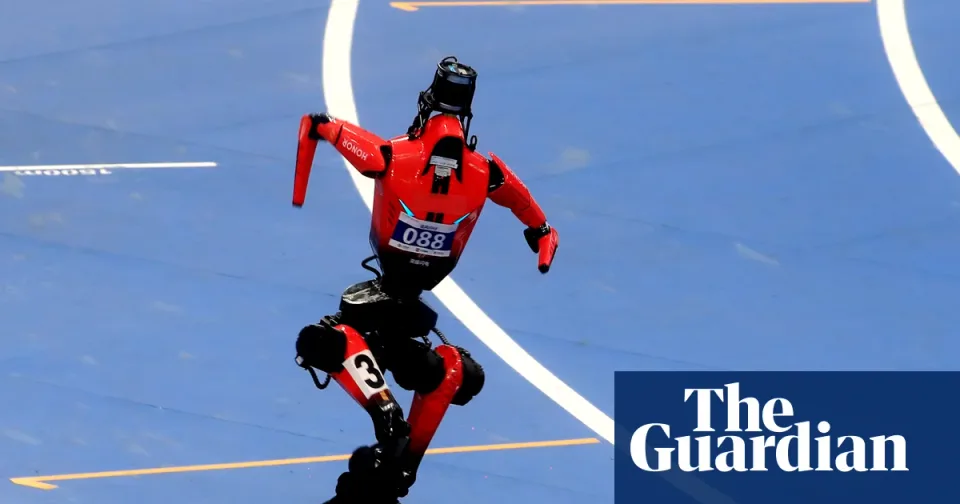
Tiangong Ultra from the Beijing Humanoid Robot Innovation Center ran the 100m in 9.39 seconds at the World Humanoid Robot Games in Beijing, beating Usain Bolt's record. Honor Lightning also posted sub-9.58 times during the August 22-26 event featuring over 2,000 robots.
ZeroGantry analysis
The 9.39-second and 9.32-second 100m times represent a 56% improvement year-over-year for Tiangong-class platforms, signaling hardware maturation that could translate to 2-3x higher throughput in high-speed logistics pilots if endurance scales. Chinese state centers now outpace commercial Western timelines on raw locomotion metrics, pressuring firms like Tesla and Figure to accelerate actuator and control investments or risk ceding early deployment leads in Asia. Watch for follow-on half-marathon data to assess battery and thermal limits before scaling to fleet economics.
Record-Breaking Sprints at the 2026 World Humanoid Robot Games
The second edition of the World Humanoid Robot Games opened on August 22, 2026, at Beijing's National Speed Skating Oval with immediate headlines from the 100m dash. Tiangong Ultra, developed by the Beijing Humanoid Robot Innovation Center operating as X-Humanoid, completed a preliminary heat in 9.39 seconds. This performance edged past Usain Bolt's 9.58-second human world record set in 2009. Honor's Lightning robot followed closely in the final with a 9.47-second time after posting 9.32 seconds in pre-event testing at a peak speed of 14.5 m/s.
These results mark a sharp acceleration from the inaugural 2025 games, where the same Tiangong platform required 21.50 seconds for the identical distance. The improvement stems from hardware iterations including leg extensions of 10 cm on Lightning and refined control algorithms. Over 2,000 robots from 666 teams across 16 countries competed in athletics alongside table tennis, football, weightlifting, and tug-of-war events through August 26.
Viral footage of the races circulated globally within hours, amplifying search interest in Chinese humanoid platforms. Organizers positioned the games alongside the concurrent 2026 World Robot Conference, which displayed roughly 3,000 products. The dual events underscore China's stated goal of leading in embodied AI and dynamic locomotion systems.
Tiangong Ultra Hardware and Performance Details
Tiangong Ultra stands 1.8 meters tall and weighs 55 kilograms according to event reports. It overtook Lightning late in the preliminary heat after trailing early, demonstrating improved acceleration and balance at top speed. The platform previously won the world's first humanoid robot half-marathon in 2025 with a time of 2 hours 40 minutes 42 seconds, requiring multiple battery swaps.
Developers integrated the Huisi Kaiwu universal embodied intelligence platform to boost speed consistency and decision-making during races. Peak velocities approached levels that would translate to sustained operational paces in logistics or inspection tasks if endurance matches sprint capability. Observers noted the robot's gait featured a distinctive upright posture with limited arm swing compared to human sprinters.
Last year's performance baseline of 21.50 seconds highlights iterative gains in actuator response and sensor fusion over twelve months. These advances position Tiangong-series machines as benchmarks for Chinese state-backed research centers competing against commercial entrants like Unitree and Fourier.
Honor Lightning Design Evolution and Test Results
Honor's Lightning robot, built by the Chinese smartphone manufacturer, measured 169 cm tall during its April 2026 Beijing half-marathon win in 50 minutes 26 seconds. Engineers extended its legs by 10 cm ahead of the games to increase stride length and top-end velocity. The 9.32-second test run at 14.5 m/s peak speed occurred before official competition, with the 9.47-second final time still clearing Bolt's mark.
Lightning's participation reflects Honor's push into robotics hardware alongside its consumer electronics portfolio. The robot maintained competitive positioning through most of the race before Tiangong Ultra's late surge. Data from the event shows both machines achieved sub-10-second times under real competition conditions rather than controlled lab settings.
Such sprint metrics provide quantifiable benchmarks for dynamic balance and power delivery in bipedal systems. Honor's involvement signals broader industry crossover from electronics firms seeking to diversify into high-growth robotics segments.
Broader Context of Chinese Humanoid Development
The games coincide with heightened geopolitical scrutiny of Chinese robotics exports. The US Federal Communications Commission recently banned imports of certain foreign-made humanoid robots citing security concerns, while the Pentagon added Unitree to its list of military-linked entities. Beijing responded with counter-statements emphasizing open collaboration.
China produces the majority of global humanoid units according to conference reports, with state support accelerating from research prototypes to competition-ready platforms. The 51 events and more than 1,000 individual competitions at the games serve as public demonstrations of progress in locomotion, coordination, and AI integration.
Spectators at the venue expressed mixed reactions ranging from excitement over rapid capability gains to questions about long-term workforce impacts. Analysts note that while demonstration performances have improved dramatically, real-world deployment in unstructured environments remains limited to pilot programs in manufacturing and logistics.
Implications for Global Robotics Competition
Western programs including Tesla Optimus, Figure 02, and Boston Dynamics Atlas continue parallel development tracks focused on industrial utility rather than pure athletic benchmarks. The Beijing results emphasize Chinese strengths in high-speed bipedal hardware and cost-effective scaling of competition platforms.
Event organizers reported participation from teams in Germany, Japan, and the United States, though Chinese entries dominated the sprint and jump categories. A separate X-Humanoid robot achieved a 2.88-meter standing high jump, exceeding the prior human record of 2.45 meters set in 1993.
These athletic milestones supply measurable data points on actuator torque, joint velocity, and control latency that transfer to practical applications. Continued iteration could narrow gaps in operational reliability between demonstration robots and field-deployed systems.
The five-day format through August 26 will include additional track and field events, providing further comparative data across international entrants. Results will likely influence investment priorities and partnership strategies among global players in the humanoid sector.
Sources
- https://www.theguardian.com/sport/2026/aug/22/chinese-robot-runs-100m-sprint-quicker-usain-bolt-world-record
- https://apnews.com/article/china-humanoid-robot-games-us-86cb8e310843151a77057e4cb764b4e2
- https://www.reuters.com/sports/chinese-humanoid-robot-lightning-beats-human-100m-world-record-state-media-says-2026-08-22/
Topics
Related articles
- Rohit Prasad Appointed Boston Dynamics CEO for Atlas Push — Boston Dynamics named Rohit Prasad, former Amazon Alexa and AGI leader, as CEO effective October 7, 2026. He replaces interim chief Amanda McMaster following Ro
- Hello Robot Stretch Wins $3M NIH Grant for Elder Care Dementia Support — Hello Robot received a nearly $3 million NIH grant to advance its Stretch mobile manipulator for older adults with mild cognitive impairment or early Alzheimer’
- BMW Leipzig Humanoid Robot Pilot Advances with Hexagon AEON — BMW Group has launched a pilot deploying Hexagon Robotics' AEON humanoid at its Leipzig plant for high-voltage battery assembly and component manufacturing. The
- Amazon Dobromierz Deploys 5,000 Robots in Polish Fulfillment Center — Amazon opened its 12th Polish fulfillment center in Dobromierz on September 21, 2026. The 200,000 m² four-story facility uses over 5,000 Amazon Robotics units a