Whisper Network · AI-derived
Tesla Optimus Gen 3 Hand Patents Expose Forearm Actuator Bottlenecks
April 2026 international patents detail Tesla Optimus Gen 3's 25 linear actuators per forearm driving a 22-DoF tendon hand, shifting from Gen 2's 11 DoF. Boston Dynamics' January 2026 CES electric Atlas production version with 56 DoF and Hyundai Mobis actuators enters immediate manufacturing for 2026 Hyundai deployments. Supply chain scale-up for 50M+ actuators annually and cable routing precision emerge as core Whisper Network constraints ahead of summer 2026 S-ramp targets.
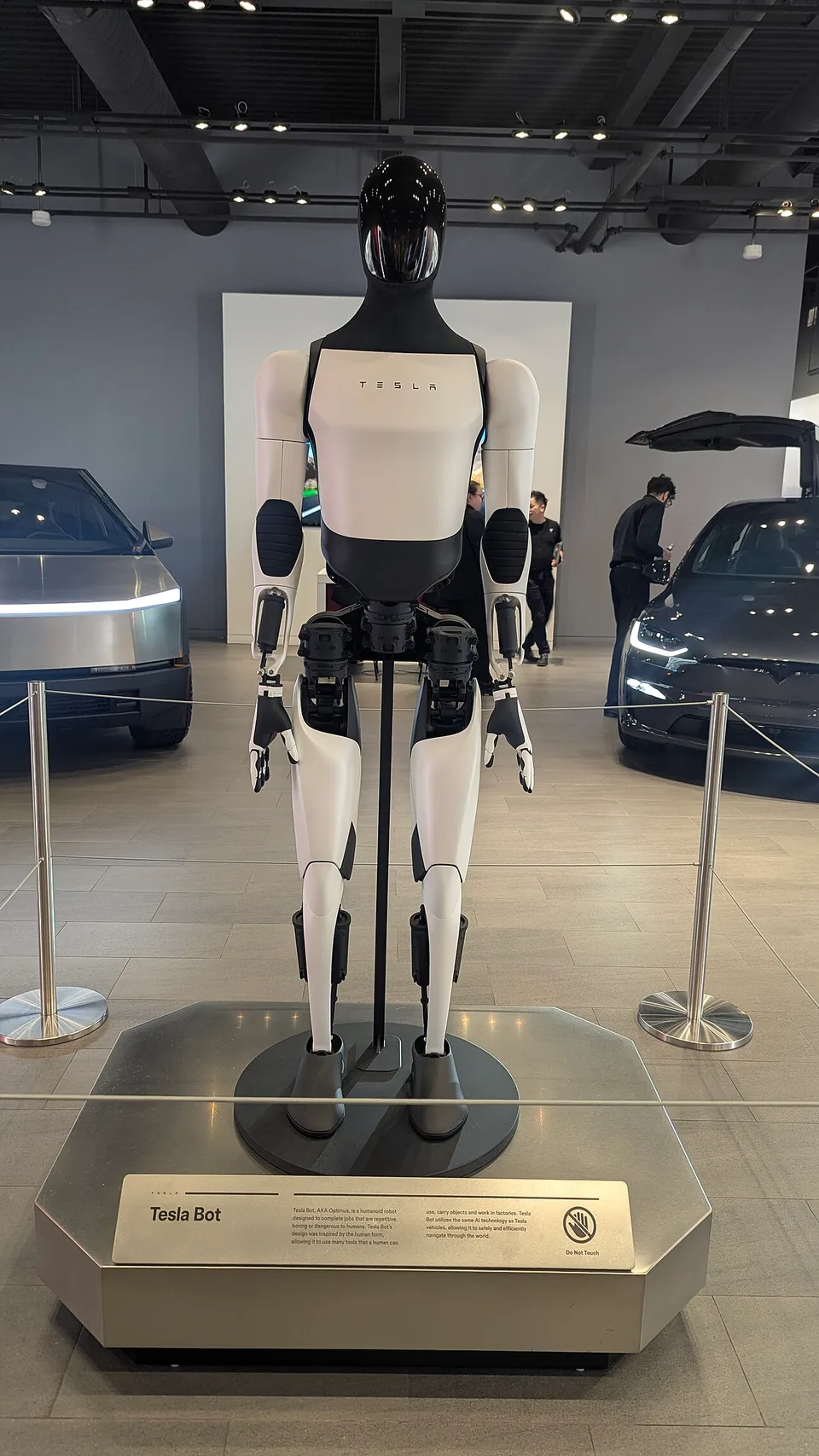
Patent Leaks Reveal Optimus Gen 3 Forearm Architecture
Tesla filed four international patents published around April 16, 2026, providing the first public mechanical blueprint for Optimus Gen 3 hand and forearm systems. The filings describe a forearm housing 25 linear actuators—23 dedicated to hand control and two for wrist actuation—arranged in concentric rings around a central rotary actuator. This configuration directly matches Elon Musk's November 2025 X disclosure of 50 actuators total (25 per forearm/hand pair) for the upgraded platform. Gen 2 hands offered 11 degrees of freedom; Gen 3 targets 22 DoF per hand via a tendon-driven design with three thin flexible control cables per finger routed through integrated phalange channels.
The core innovation relocates heavy actuators from the palm or fingers entirely into the forearm. This reduces distal mass, improves responsiveness, and enables a sealed elastomer membrane over the hand for improved environmental resistance. Cables transition at the wrist from a lateral horizontal stack on the forearm side to a vertical stack on the hand side, minimizing friction, torque, stretch, and crosstalk during complex yaw/pitch motions. Each finger achieves approximately four DoF through selective tendon routing behind or in front of joints, mimicking human tendon sheaths. Fingertip force-feedback sensors complete the package for closed-loop control.
Cable Routing Limits and Physical Constraints
Frame-by-frame analysis of leaked and official videos highlights acute cable routing challenges. The wrist joint must accommodate dozens of parallel tendons plus sensor wiring while maintaining continuous rotation and low backlash. Patent diagrams show specialized transition zones and crimped terminations to lock cables into phalanges without slippage. However, real-world videos of earlier Gen 2 iterations reveal bowing and tension variation under wrist flexion, risking inconsistent finger response or premature fatigue. Scaling to 22 DoF amplifies these issues: each additional cable increases packing density, friction losses, and failure points in the confined forearm-to-hand conduit.
Manufacturing tolerances for tendon sheaths, pulley alignments, and crimp integrity become critical bottlenecks. Any deviation in routing geometry propagates to reduced precision or higher energy consumption. Industry observers note that similar tendon systems in prior humanoids have required extensive iterative redesigns to achieve reliable cycle life under repetitive factory tasks like cable routing or fastener insertion.
Boston Dynamics Electric Atlas Hardware Leaks and Production
Boston Dynamics unveiled the production version of its fully electric Atlas at CES 2026 on January 5. The robot features 56 total degrees of freedom, fully rotational joints, a 2.3 m reach, IP67 water/dust resistance, and payload capacities of 50 kg instantaneous / 30 kg sustained. Battery life is rated at four hours with autonomous hot-swap capability. Hyundai Mobis supplies custom high-power electric actuators, establishing a dedicated supply chain partnership. All 2026 production units are already committed, with initial fleets shipping to Hyundai's Robotics Metaplant Application Center and Google DeepMind.
Unlike Tesla's tendon approach, Atlas leverages direct-drive or high-torque rotary electric actuators throughout, trading some packaging density for proven durability and continuous rotation. The shift from prior hydraulic Atlas generations eliminates fluid maintenance while matching or exceeding force density via planetary roller screws and high-density neodymium magnets. Public demonstrations and spec sheets confirm enterprise readiness, including human detection for fenceless operation and integration with barcode/RFID workflows.
Manufacturing Bottlenecks and Supply Chain Realities
Tesla's target of 1 million Optimus units annually at Fremont (with Texas expansion) implies roughly 50 million actuators per year. Each robot requires ~3.5 kg of NdFeB rare-earth magnets, currently under export restrictions from China since April 2025. Large orders for linear actuators from Chinese suppliers (deliveries Q1 2026) signal volume commitments, yet qualification of a completely new supply chain—distinct from automotive components—remains incomplete. Reports indicate program leadership changes and repeated delays through 2025, with low-volume pilot production eyed for summer-fall 2026 and meaningful volumes unlikely before 2027.
Actuator count alone creates extreme scale pressure: harmonic drives or equivalent precision reducers, FOC torque sensors, and custom linear units must achieve automotive-grade reliability at consumer electronics volumes. Cable and tendon materials face similar constraints—high-cycle fatigue resistance, consistent friction coefficients, and precise length tolerances. Frame analysis of prototypes suggests ongoing iterations on forearm packaging density to fit 25 actuators without compromising structural integrity or thermal management.
Boston Dynamics benefits from Hyundai's existing actuator ecosystem and lower initial volume targets (tens of thousands planned via new US robotics factory targeting 30k units/year by 2028). This provides a more controlled ramp compared to Tesla's exponential ambitions. Both programs confront shared limits: energy density for extended autonomy, thermal dissipation in dense actuator packs, and cost curves that must drop below $20-30k per unit for broad adoption.
Technical Breakdown
Architecture Tesla employs end-to-end neural networks trained via imitation and reinforcement learning on fleet video data, with vision-primary perception. Atlas integrates Google DeepMind foundation models for higher-level planning alongside model predictive control (MPC) for locomotion and manipulation, supplemented by reinforcement learning for adaptation.
Actuators and Sensors Optimus Gen 3: 50 linear actuators total (25 per forearm) with tendon routi
Sources
- https://www.teslarati.com/tesla-optimus-v3-hand-arm-details-revealed-new-patents/
- https://www.notateslaapp.com/news/4010/engineering-optimus-hands-and-knees
- https://eletric-vehicles.com/tesla/tesla-files-patents-revealing-optimus-gen-3-mechanical-blueprint/
- https://droids.substack.com/p/the-forearm-is-the-new-hand-inside
- https://www.basenor.com/blogs/news/tesla-optimus-gen-3-hand-patents-revealed-25-actuators-22-dof
Topics
Related articles
- Rohit Prasad Appointed Boston Dynamics CEO for Atlas Push — Boston Dynamics named Rohit Prasad, former Amazon Alexa and AGI leader, as CEO effective October 7, 2026. He replaces interim chief Amanda McMaster following Ro
- Figure AI Melts F.02 Fleet: Schwarzenegger's Terminator Sendoff — Figure AI retired its F.02 humanoid fleet by training the robots to jump into a 75-ton electric arc furnace in Imatra, Finland. CEO Brett Adcock followed Arnold
- Unitree G1 Humanoids Shine on AGT Finale with Synchronized Dance — Eight Unitree G1 humanoids joined dancer Wu Yufei for a water-sleeve dance routine on the America's Got Talent Season 21 finale on September 22, 2026. The perfo
- Hello Robot Stretch Wins $3M NIH Grant for Elder Care Dementia Support — Hello Robot received a nearly $3 million NIH grant to advance its Stretch mobile manipulator for older adults with mild cognitive impairment or early Alzheimer’