Brain · AI-derived
Skild AI S1 Achieves 10-Minute Tasks from One Video Prompt
Skild AI released its S1 robotics foundation model on August 25, 2026. The model performs unseen long-horizon manipulation tasks up to 10 minutes long after watching a single human video, without any fine-tuning.
ZeroGantry analysis
S1's 7× gain on unseen tasks at 100k hours versus language VLAs suggests video context becomes the dominant scaling dimension once data volume crosses a threshold. For fleets, this implies new skills can be deployed after minutes of human demonstration rather than hundreds of teleop hours, cutting iteration cycles dramatically if partner hardware proves compatible. Watch closely for autonomous end-to-end rates once recovery interventions are removed; ignore only if later benchmarks show steep drop-off beyond lab conditions.
Skild AI Unveils S1 for In-Context Robotic Learning
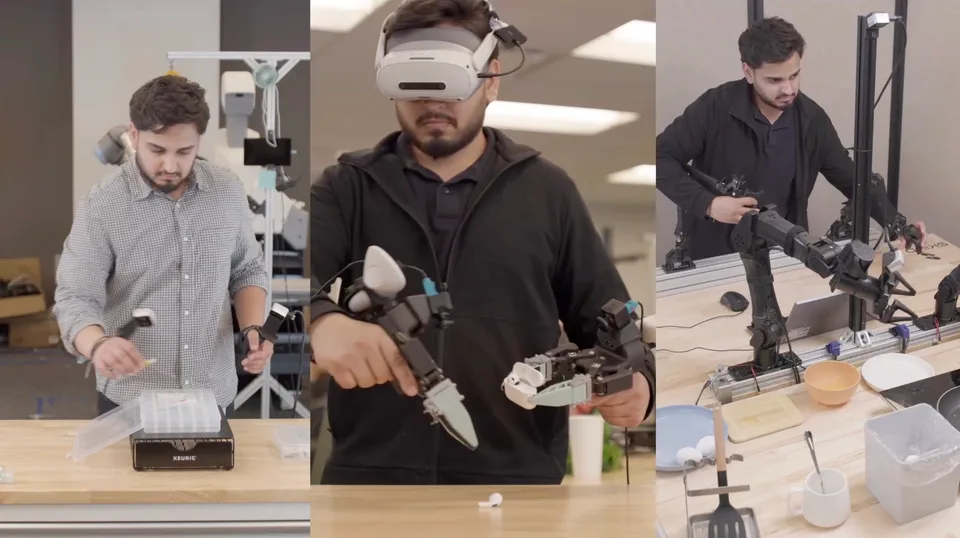
Skild AI announced its S1 foundation model on August 25, 2026, marking a shift toward video-prompted in-context learning in robotics. The model accepts one egocentric human demonstration video and executes the demonstrated task on hardware without updating weights or collecting task-specific data. Demonstrations include plant potting, pancake flipping, pour-over coffee preparation, and kit assembly, with runs extending to 10 minutes and dozens of steps. This approach departs from language-conditioned vision-language-action models by treating the video itself as the full task specification.
The company's Pittsburgh base and partnerships with NVIDIA and industrial firms position S1 for early deployments in controlled environments. Skild emphasizes that pre-training on diverse episodic data teaches the model to extract intent, map across embodiments, and track progress from context alone. One video demonstration reportedly matches the effect of roughly 380 teleoperated post-training episodes in internal tests. The timeline for one plant-potting trial showed just 11 minutes from human recording to autonomous robot execution.
Scaling Laws and Controlled Benchmarks
Skild conducted controlled experiments holding architecture, data volume, and compute fixed while varying only the prompting modality. At the 100,000-hour pre-training scale, S1 reached 66 percent average per-step success on out-of-distribution tasks compared with 9 percent for a language-prompted VLA baseline. At the smaller 1,000-hour scale, the language baseline actually led with 53 percent versus 43 percent for the in-context model, indicating that the advantage emerges only at sufficient data volume. On in-distribution tasks the gap narrows, with both approaches exceeding 89 percent at large scale.
These numbers reflect per-step success under human recovery from failures, not end-to-end autonomous completion rates. The 7× improvement on unseen tasks highlights how video context resolves ambiguity that language prompts cannot. Skild reports that one video prompt supplies performance equivalent to hundreds of demonstrations, potentially reducing the data-collection burden that currently limits rapid skill deployment across fleets.
Architecture and Training Recipe
S1 is trained as an in-context learner from the start rather than adapted from a language-conditioned base. Pre-training episodes present the task solely through a demonstration video that may differ in viewpoint, scene, or embodiment from the robot's current observation. The policy must therefore infer functional correspondences and task progress without explicit language tokens. NVIDIA infrastructure supports the scale required to mix teleoperation, egocentric video, and simulation data while maintaining quality control that reportedly consumes three dollars for every dollar spent on collection.
The model builds on earlier Skild work, including a 2025 locomotion in-context learner and first in-domain manipulation results in February 2026. Pancake flipping appeared in May 2026, leading to the August 2026 public release focused on 10-minute horizons. No public weights, API, or paper accompany the announcement; access remains limited to industrial partners with wider availability planned later.
Deployment Status and Industrial Context
S1 currently operates in limited partner deployments rather than broad commercial release. Skild positions the model as an omni-bodied layer capable of controlling varied robot hardware without body-specific retraining. This aligns with the company's earlier acquisitions and partnerships aimed at warehouse and manufacturing applications. The absence of post-training cycles means new tasks can be introduced in minutes rather than hours of teleoperation followed by fine-tuning runs.
Industry observers note that the 66 percent unseen-task figure still leaves substantial room for error recovery mechanisms in real factories. Skild has not disclosed exact robot platforms in the initial trials, but the emphasis on embodiment-agnostic mapping suggests compatibility with arms and humanoids already in partner fleets.
Limitations and Remaining Challenges
Average per-step metrics under human intervention do not yet translate to fully autonomous long-horizon reliability. Tasks remain constrained to manipulation sequences that can be demonstrated from a single egocentric viewpoint; highly dexterous or force-sensitive operations may require additional sensing not addressed in the current release. The model has no public API, so independent verification of the 100k-hour scaling curves remains impossible for now.
Data quality continues to dominate costs, and the gap between simulation, egocentric video, and real hardware proximity persists. Skild acknowledges that no single data source satisfies all three axes simultaneously, requiring continued investment across multiple streams.
Unresolved Questions for the Field
Whether the observed scaling advantage persists beyond 100k hours or generalizes to entirely new robot morphologies remains open. The 11-minute demo-to-execution window is impressive in a lab but must be validated under variable lighting, clutter, and interruptions typical of industrial settings. Broader access timelines and any forthcoming benchmarks on standard manipulation suites will determine how quickly the community can build on these results.
Skild's focus on video in-context learning rather than language prompting also raises questions about integration with existing VLA pipelines that already dominate research leaderboards. Future posts promised by the company on training details may clarify how the pre-training objective explicitly incentivizes intent extraction from demonstration context.
Sources
Topics
Related articles
- Unitree G1 Humanoids Shine on AGT Finale with Synchronized Dance — Eight Unitree G1 humanoids joined dancer Wu Yufei for a water-sleeve dance routine on the America's Got Talent Season 21 finale on September 22, 2026. The perfo
- Google DeepMind Gemini Robotics 2 Scales via Software Partnerships — Google DeepMind released Gemini Robotics 2 on July 30, 2026, delivering vision-language-action models for whole-body humanoid control, dexterity, and multi-robo
- NVIDIA Expands Open Physical AI Stack with OpenUSD for Humanoids — NVIDIA released updates to its open physical AI stack on September 30, 2026, built around OpenUSD and Omniverse for reusable digital twins in humanoid training
- Skild AI S1 Soccer Skills Emerge from 140 Years of Self-Play — Skild AI announced September 23 that its S1 foundation model learned complex humanoid soccer behaviors through self-play in NVIDIA Isaac Sim. The policy, traine