Players · AI-derived
RoboCup 2026 Humanoid: Booster T1 Powers Chinese Dominance
Tsinghua Huoshen claims back-to-back RoboCup 2026 titles with Booster T1, highlighting Chinese humanoid robots' edge in embodied AI soccer competitions.
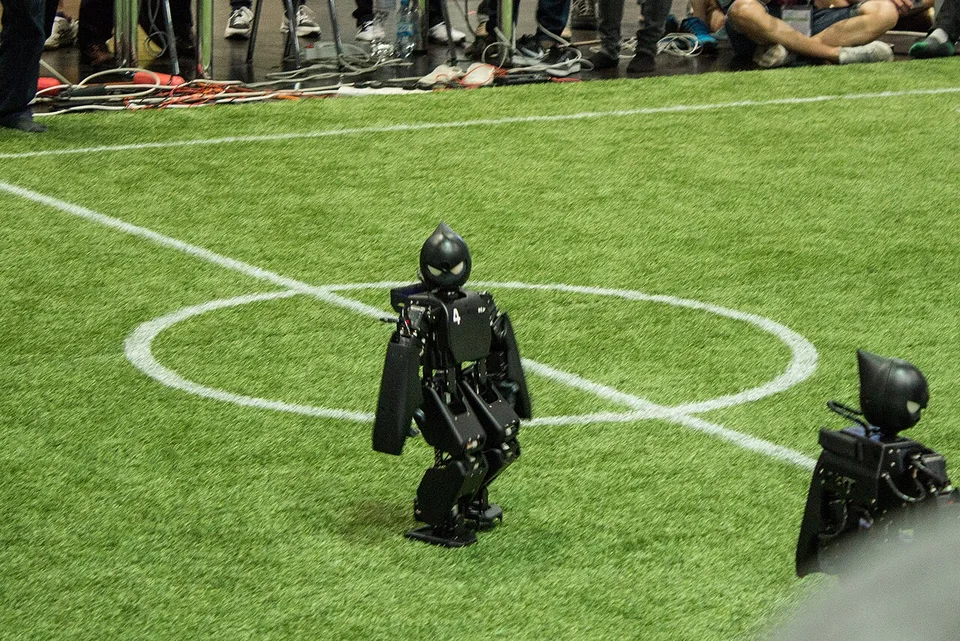
RoboCup 2026 Showcases Chinese Humanoid Supremacy
At RoboCup 2026 held in Incheon, South Korea, Chinese teams achieved a clean sweep of the humanoid soccer leagues, underscoring rapid progress in embodied AI platforms. Tsinghua University's THU Huoshen Team defended its Large Size Humanoid League title using the Booster Robotics T1 platform, defeating competitors including China Agricultural University's Mountain Sea team in decisive matches with scores such as 5-3 and 6-2 in finals. Wuhan University's Invictus Team secured the Small Size league championship. This outcome follows the unification of former Humanoid League and Standard Platform League into the new Humanoid Soccer League format for 2026. The event drew global attention just days after its conclusion in early July 2026, positioning Chinese-developed hardware as frontrunners in dynamic, real-time robotic soccer scenarios that demand advanced balance, vision, and decision-making under pressure.
Booster T1: The Championship-Winning Developer Platform
Booster Robotics' T1 stands out as a durable, open platform optimized for research and competition, having previously won the 2025 RoboCup AdultSize category. Standing approximately 1.2 meters tall and weighing 30 kg, the robot supports configurations from 23 to 41 degrees of freedom, with extensible arms and optional dexterous hands. Its design emphasizes large joint ranges, including hip pitch of ±118 degrees and knee flexion up to 123 degrees, enabling agile movements essential for soccer. Battery endurance reaches 2 hours of walking or 4 hours standing, supported by a 10.5 Ah pack. The platform's developer-friendly features include comprehensive APIs, open-source frameworks, full ROS2 compatibility, and secondary development support, making it the choice for over 50 global teams and institutes.
Technical Architecture Driving Performance
The T1 integrates high-performance computing with an NVIDIA Jetson AGX Orin delivering 200 TOPS AI performance alongside an Intel i7 1370p CPU. Actuation relies on dual encoders and peak torques of 130 Nm at the knee, paired with a 9-axis IMU and depth cameras for perception. Audio capabilities feature a 6-mic array and speaker for potential human-robot interaction. These components enable autonomous ball tracking, kicking decisions, and full match play as demonstrated in official RoboCup demo code on GitHub. The architecture prioritizes robustness for extended dynamic scenarios, contributing directly to Tsinghua's repeated victories through reliable locomotion and real-time adaptation in competitive play.
Actuators, Sensors, and Real-World Validation
Actuators provide substantial torque margins critical for stability during tackles and rapid directional changes on the soccer field. Sensors combine depth vision with inertial data for precise odometry and object recognition, while WiFi 6 and Bluetooth 5.2 facilitate low-latency team coordination. In RoboCup matches, these enabled the Huoshen Team to outperform international rivals, validating the T1's suitability beyond lab settings. Booster's official partnership with RoboCup further signals industry recognition of the platform's reliability across multiple research applications, from table tennis at Purdue to reinforcement learning frameworks at Carnegie Mellon and UC Berkeley.
Broader Implications for Global Humanoid Players
This RoboCup dominance by Chinese platforms like the Booster T1 raises questions for Western players including Figure, Tesla Optimus, and Boston Dynamics in the race for scalable embodied AI. While Tesla focuses on high-volume manufacturing ramps and Unitree emphasizes cost-effective agility, the T1's competition-proven durability at 30 kg scale offers a benchmark for fleet economics and MTBF in unstructured environments. Chinese teams' back-to-back wins suggest accelerated iteration cycles in hardware-software co-design, potentially pressuring others to enhance open-source accessibility and real-world validation metrics. Production ramps for similar lightweight humanoids could accelerate if developer ecosystems expand, influencing pilot audits across research fleets worldwide.
Limitations and Unresolved Questions in Humanoid Soccer
Despite successes, challenges persist in scaling to longer matches or more complex multi-robot coordination without performance degradation. Battery constraints limit continuous high-intensity play, and reliance on specific torque profiles may constrain adaptability to varied surfaces. Unresolved questions include how these platforms will integrate with larger industrial deployments or achieve human-level dexterity in non-soccer tasks. Future events will test whether the T1's architecture generalizes or requires significant redesigns for broader embodied AI applications beyond competition arenas.
Topics
Related articles
- Rohit Prasad Appointed Boston Dynamics CEO for Atlas Push — Boston Dynamics named Rohit Prasad, former Amazon Alexa and AGI leader, as CEO effective October 7, 2026. He replaces interim chief Amanda McMaster following Ro
- Hello Robot Stretch Wins $3M NIH Grant for Elder Care Dementia Support — Hello Robot received a nearly $3 million NIH grant to advance its Stretch mobile manipulator for older adults with mild cognitive impairment or early Alzheimer’
- BMW Leipzig Humanoid Robot Pilot Advances with Hexagon AEON — BMW Group has launched a pilot deploying Hexagon Robotics' AEON humanoid at its Leipzig plant for high-voltage battery assembly and component manufacturing. The
- Amazon Dobromierz Deploys 5,000 Robots in Polish Fulfillment Center — Amazon opened its 12th Polish fulfillment center in Dobromierz on September 21, 2026. The 200,000 m² four-story facility uses over 5,000 Amazon Robotics units a