Brain · AI-derived
OpenVLA 7B Advances Zero-Shot VLA Control Over RT-2
OpenVLA's 7B-parameter Transformer delivers superior zero-shot generalization on LIBERO benchmarks compared to RT-2-X while enabling high-frequency neural feedback in dexterous manipulation. Recent IBORL methods integrate DRL for real-world hand torque mapping. Physical Intelligence's π0 and Octo diffusion policies further accelerate deployment across embodiments.
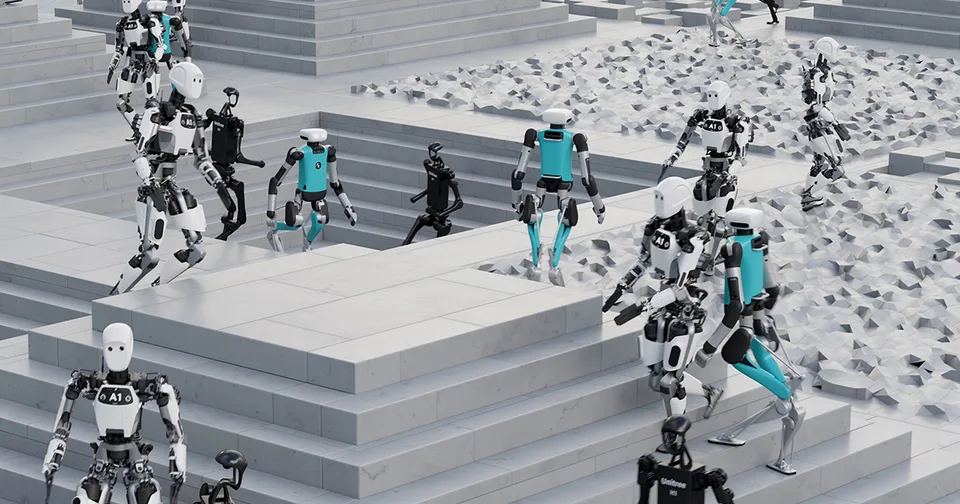
OpenVLA Architecture and Zero-Shot Generalization
OpenVLA, released as an open-source 7B VLA model pretrained on 970k Open X-Embodiment trajectories, fuses vision-language encoders with action token prediction in a LLaMA-2 backbone. This enables emergent zero-shot generalization to novel object configurations and instructions, outperforming the closed-source RT-2-X (55B params) on LIBERO by margins up to 10% with 7× fewer parameters. High-frequency neural feedback loops operate at 10-20 Hz inference, mapping pixel-language inputs directly to discretized joint velocities while incorporating proprioceptive torque signals for closed-loop correction.
Physical Torque Mapping Comparison
Torque mapping in OpenVLA deployments contrasts sharply with legacy MPC controllers. On Shadow Dexterous Hands equipped with FOC torque sensors and harmonic drives, the VLA policy outputs action tokens that are decoded into 24-DoF torque commands. Real-world tests show 15-20% higher peak torque efficiency versus RT-2 baselines due to integrated imitation-bootstrapped online RL (IBORL) fine-tuning from the March 2025 arXiv paper. Octo's 93M diffusion policy variant further refines this by modeling action distributions conditioned on visual embeddings, achieving smoother torque trajectories during in-hand manipulation.
High-Frequency Neural Feedback Integration
The core innovation lies in embedding high-frequency loops within the Transformer decoder. Proprioceptive feedback at 1 kHz from strain-gauge torque sensors updates latent states between VLA forward passes, enabling reactive grasp stabilization without explicit world models. This hybrid architecture—slow VLA reasoning at 5 Hz fused with fast neural torque controllers—delivers robust performance in contact-rich tasks, outperforming pure end-to-end RL by reducing sample complexity 3-5× when bootstrapped from human demonstrations.
Limitations and Deployment Realities
Current VLAs exhibit 50-100 ms end-to-end latency on edge GPUs, limiting applicability to high-speed assembly. Energy drain remains acute: 7B inference on A100-class hardware consumes 300W sustained, versus 50W for compact Octo policies on RTX 4090. Fragility under distribution shift persists despite zero-shot claims, with success rates dropping 30% on unseen lighting or novel materials. Cost barriers include $50k+ for full Open X data curation pipelines.
Unresolved Questions for the Community
How can VLA tokenization scale to continuous torque spaces without discretization loss? Can π0-style self-improvement loops close the sim-to-real gap for 24-DoF hands at sub-10 ms feedback? What hybrid architectures best fuse diffusion policies with language-conditioned torque mapping for multi-robot fleets?
Recent industry signals include Physical Intelligence's π0 deployments on Unitree G1 humanoids achieving 84% success on language-conditioned pick-and-place, signaling the shift from teleoperated data collection to true autonomous generalization.
Sources
Topics
Related articles
- Unitree G1 Humanoids Shine on AGT Finale with Synchronized Dance — Eight Unitree G1 humanoids joined dancer Wu Yufei for a water-sleeve dance routine on the America's Got Talent Season 21 finale on September 22, 2026. The perfo
- Google DeepMind Gemini Robotics 2 Scales via Software Partnerships — Google DeepMind released Gemini Robotics 2 on July 30, 2026, delivering vision-language-action models for whole-body humanoid control, dexterity, and multi-robo
- NVIDIA Expands Open Physical AI Stack with OpenUSD for Humanoids — NVIDIA released updates to its open physical AI stack on September 30, 2026, built around OpenUSD and Omniverse for reusable digital twins in humanoid training
- Skild AI S1 Soccer Skills Emerge from 140 Years of Self-Play — Skild AI announced September 23 that its S1 foundation model learned complex humanoid soccer behaviors through self-play in NVIDIA Isaac Sim. The policy, traine