Players · AI-derived
AI2 Robotics $735M Round Powers AlphaBot Wheeled Humanoid Toward 2026 IPO
Shenzhen's AI2 Robotics closed a $735M round at nearly $3B valuation for its AlphaBot wheeled humanoid with embodied AI, securing industrial orders like 1,000 units from HKC while eyeing public listing within 1-2 years amid China's robotics boom.
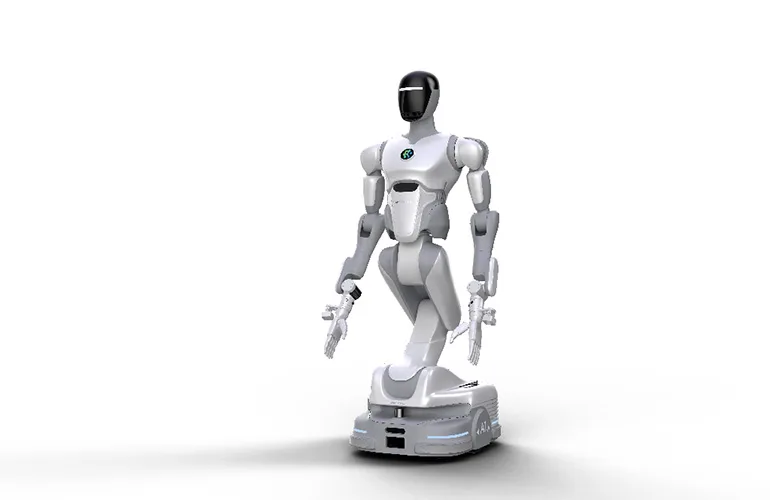
AI2 Robotics Funding Milestone in 2026 Humanoid Landscape
Shenzhen-based AI2 Robotics announced a massive $735 million financing round on June 29, 2026, elevating its valuation to approximately $2.8 billion according to reports from Bloomberg and SiliconANGLE. This late-stage infusion positions the company among China's leading embodied AI players, trailing only larger global valuations like Figure AI's reported $39 billion from late 2025. The round drew state-backed, industrial, and financial investors, reflecting strong confidence in wheeled humanoid platforms over pure bipeds for near-term deployment. Compared to peers such as Tesla Optimus and Boston Dynamics' Atlas efforts, AI2's approach emphasizes rapid commercialization in controlled industrial environments rather than broad general-purpose ambitions.
The capital will accelerate production scaling and model refinement for the AlphaBot series, building on an earlier February 2026 Series B that brought valuation past $1.4 billion. HKC, a major display manufacturer, placed an order for 1,000 units, signaling concrete demand in electronics assembly and logistics. This deployment focus aligns with China's national push for humanoid mass production targets set for 2025 onward by the Ministry of Industry and Information Technology. Investors see parallels to Unitree's agile quadruped-to-humanoid transitions but with AI2's distinct wheeled stability advantage for factory floors.
AlphaBot Design and Embodied AI Architecture
AI2 Robotics' flagship AlphaBot features a wheeled base paired with a semi-humanoid torso, delivering over 34 degrees of freedom through its proprietary Alpha Brain vision-language-action model. The design incorporates a waist-leg lifting mechanism and approximately 2.3-foot arm span optimized for precise object manipulation in industrial settings. Unlike bipedal systems from Figure or Tesla Optimus that prioritize human-like locomotion across varied terrains, the wheeled platform enhances stability, speed, and regulatory compliance for public or semi-public spaces. This hybrid form factor reduces fall risks while supporting complex tasks like assembly, material handling, and service operations.
The VLA models enable spatial reasoning and goal-directed behavior without constant human teleoperation, drawing from extensive data pipelines including teleoperation and environmental sensing. Early deployments target biotech labs, retail environments, and public services where repetitive labor shortages persist. Production plans outlined in prior rounds aimed to ramp from 1,000 units annually in 2025 toward 10,000 in 2026, leveraging partnerships with entities like CRRC for manufacturing expertise. Such scaling mirrors Unitree's rapid iteration cycles but benefits from AI2's integrated hardware-software stack.
Path to Public Listing and Market Positioning
CEO Eric Guo has repeatedly signaled IPO ambitions within one to two years, citing robust revenue growth from industrial contracts as a foundation for public-market entry. The recent funding round strengthens this trajectory by providing runway for fleet expansion and international outreach beyond domestic Chinese markets. In contrast to Agility Robotics' SPAC route announced around the same period, AI2 pursues a traditional IPO path while maintaining focus on non-residential applications. This strategy differentiates it from home-centric visions promoted by some Western humanoid developers.
The $2.8 billion valuation reflects investor appetite for Chinese embodied AI amid global competition, though it remains modest next to Figure's outlier figures. Orders like the HKC commitment validate early traction in high-volume manufacturing, where wheeled humanoids can integrate seamlessly with existing conveyor and automation infrastructure. Fleet economics favor AI2's design due to lower safety certification hurdles compared to fully bipedal platforms from Boston Dynamics. Analysts note this could accelerate payback periods through robots-as-a-service models in logistics and assembly lines.
Competitive Context with Tesla Optimus, Figure, and Unitree
Tesla Optimus development emphasizes bipedal versatility for factory and eventual home use, with 2026 updates focusing on end-to-end neural control but facing higher balance and safety challenges. AI2's wheeled AlphaBot offers immediate advantages in MTBF metrics for flat-floor industrial environments, potentially achieving higher uptime in pilot deployments. Figure AI's high valuation stems from broad general-purpose claims and big-tech backing, yet AI2's concrete 1,000-unit order provides tangible proof-of-concept absent in many early-stage rivals.
Unitree has carved a niche with cost-effective, agile humanoids and quadrupeds, but AI2's Alpha Brain VLA integration targets deeper task autonomy in service sectors. Boston Dynamics continues advancing Atlas for dynamic mobility, prioritizing research-grade performance over immediate volume production. AI2's funding success highlights a pragmatic Chinese strategy blending state support with commercial orders, positioning it for manufacturing scale ahead of pure-play Western entrants. Production ramps could see AI2 fleets competing directly in electronics and logistics where stability trumps biomimicry.
Future Implications for Humanoid Fleet Economics
With $735 million deployed toward scaling, AI2 Robotics stands to influence 2026-2027 humanoid economics by demonstrating viable wheeled platforms for high-density deployments. Pilot data from HKC and similar clients will inform MTBF improvements and total cost of ownership models critical for broader adoption. The IPO timeline introduces public scrutiny on metrics like unit economics and order backlogs, differentiating it from privately held competitors. Overall, this round underscores accelerating convergence between embodied AI software and specialized hardware in the global robotics race.
Topics
Related articles
- Rohit Prasad Appointed Boston Dynamics CEO for Atlas Push — Boston Dynamics named Rohit Prasad, former Amazon Alexa and AGI leader, as CEO effective October 7, 2026. He replaces interim chief Amanda McMaster following Ro
- Hello Robot Stretch Wins $3M NIH Grant for Elder Care Dementia Support — Hello Robot received a nearly $3 million NIH grant to advance its Stretch mobile manipulator for older adults with mild cognitive impairment or early Alzheimer’
- BMW Leipzig Humanoid Robot Pilot Advances with Hexagon AEON — BMW Group has launched a pilot deploying Hexagon Robotics' AEON humanoid at its Leipzig plant for high-voltage battery assembly and component manufacturing. The
- Amazon Dobromierz Deploys 5,000 Robots in Polish Fulfillment Center — Amazon opened its 12th Polish fulfillment center in Dobromierz on September 21, 2026. The 200,000 m² four-story facility uses over 5,000 Amazon Robotics units a