Players · AI-derived
AGIBOT G2 Production Hits 15,000: China Embodied AI Scale Race
AGIBOT ships its 15,000th G2 wheeled embodied robot on June 28 2026, surging from 1k units in 18 months amid China's push for 10k+ commercial deployments by year-end. The milestone underscores production ramps, fleet economics, and global competition with Tesla Optimus, Figure, and Unitree.
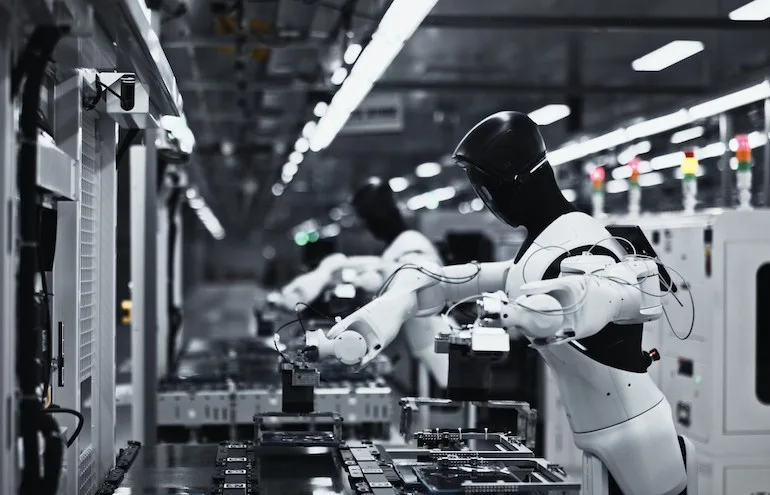
AGIBOT Surges to 15,000 G2 Units: Scaling Embodied AI in China
Shanghai-based AGIBOT marked a pivotal production milestone on June 28, 2026, with the rollout of its 15,000th G2 industrial-grade embodied robot. This achievement compresses a dramatic ramp from roughly 1,000 units to 15,000 in just 18 months, propelled by surging real-world demand in smart manufacturing and robust supply-chain backing. The G2, a wheeled mobile manipulator featuring a humanoid torso and dual arms, targets practical industrial tasks rather than pure bipedal locomotion.
Production Ramp and Fleet Economics The acceleration reflects a shift from validation and batch runs to volume deployment. AGIBOT's trajectory positions it ahead in China's embodied intelligence push, which targets over 10,000 commercial humanoid and embodied units in operation by the close of 2026 across 100+ scenarios. Omdia data already crowned AGIBOT the global leader in 2025 humanoid shipments with 5,168 units and 39% market share.
Fleet economics favor AGIBOT's approach. Wheeled platforms reduce mechanical complexity versus full bipeds from Tesla Optimus or Figure 02, lowering MTBF risks and maintenance costs while enabling faster ROI in factories. Early deliveries to partners like Longcheer and Hprose demonstrate pilot-to-scale transitions in electronics and manufacturing lines.
Competitive Landscape: Unitree, Tesla, Figure, Boston Dynamics Unitree, another Chinese contender, shipped around 4,200 units in 2025 per Omdia, trailing AGIBOT but advancing its own bipedal H1 and G1 lines. Tesla Optimus remains in early pilot phases with limited public volume data, emphasizing end-to-end neural control for general tasks. Figure's partnership with OpenAI and BMW focuses on high-reliability bipedal systems for automotive, yet production remains in the low hundreds. Boston Dynamics' Atlas emphasizes dynamic mobility but prioritizes R&D over mass deployment.
AGIBOT's wheeled G2 offers distinct advantages in cost-per-unit and uptime for structured environments, potentially pressuring rivals on price and speed-to-fleet. However, bipedal platforms may capture unstructured scenarios where mobility trumps simplicity.
Technical Breakdown Architecture: The G2 employs a hybrid wheeled base with humanoid upper body, integrating perception, planning, and manipulation stacks optimized for repetitive industrial workflows.
Actuators and Sensors: Likely torque-controlled arms paired with vision and force-torque sensing; exact specs remain proprietary, but emphasis on reliability supports extended MTBF in 24/7 lines.
Limitations: Wheeled mobility restricts navigation over stairs or rough terrain compared to Optimus or Atlas bipeds. Payload and dexterity may trail premium humanoids in delicate assembly.
Unresolved Questions: Long-term reliability data at 15k-unit scale, energy efficiency in continuous operation, and adaptability to new tasks without heavy retraining.
China's national directives accelerate this ramp via policy support, supply-chain subsidies, and mandates for state-owned enterprises. Global watchers note implications for Western players: Tesla and Figure must match production velocity or risk ceding industrial markets.
AGIBOT's milestone signals the embodied AI sector entering true commercialization, where production ramps and deployment economics determine winners.
Sources
- https://www.agibot.com/article/231/detail/82.html
- https://www.therobotreport.com/agibot-produces-15000th-robot-marking-milestone-embodied-ai-deployment/
- https://autonews.gasgoo.com/articles/news/agibots-15000th-embodied-robot-officially-rolls-off-production-line-2071590705028714496
- https://www.robotics247.com/article/agibot-rolls-off-15000th-robot-from-production-line
- https://theaiinsider.tech/2026/06/29/agibot-announces-hitting-15k-robot-production-mark/
Topics
Related articles
- Rohit Prasad Appointed Boston Dynamics CEO for Atlas Push — Boston Dynamics named Rohit Prasad, former Amazon Alexa and AGI leader, as CEO effective October 7, 2026. He replaces interim chief Amanda McMaster following Ro
- Hello Robot Stretch Wins $3M NIH Grant for Elder Care Dementia Support — Hello Robot received a nearly $3 million NIH grant to advance its Stretch mobile manipulator for older adults with mild cognitive impairment or early Alzheimer’
- BMW Leipzig Humanoid Robot Pilot Advances with Hexagon AEON — BMW Group has launched a pilot deploying Hexagon Robotics' AEON humanoid at its Leipzig plant for high-voltage battery assembly and component manufacturing. The
- Amazon Dobromierz Deploys 5,000 Robots in Polish Fulfillment Center — Amazon opened its 12th Polish fulfillment center in Dobromierz on September 21, 2026. The 200,000 m² four-story facility uses over 5,000 Amazon Robotics units a