Editorial · AI-derived
1X NEO Ready for Home 2026? New Yorker Exposes Humanoid Risks
The New Yorker’s June 2026 probe into 1X NEO reveals tendon actuators, teleoperation crutches, and fall risks that undermine 10k+ pre-orders at $20k. As rivals like Figure 03 and Optimus chase factory ramps, real MTBF data and home safety gaps spell trouble for 2026 humanoid deployment.
EDITORIAL / OPINION
The New Yorker’s June 2026 Reality Check on 1X NEO
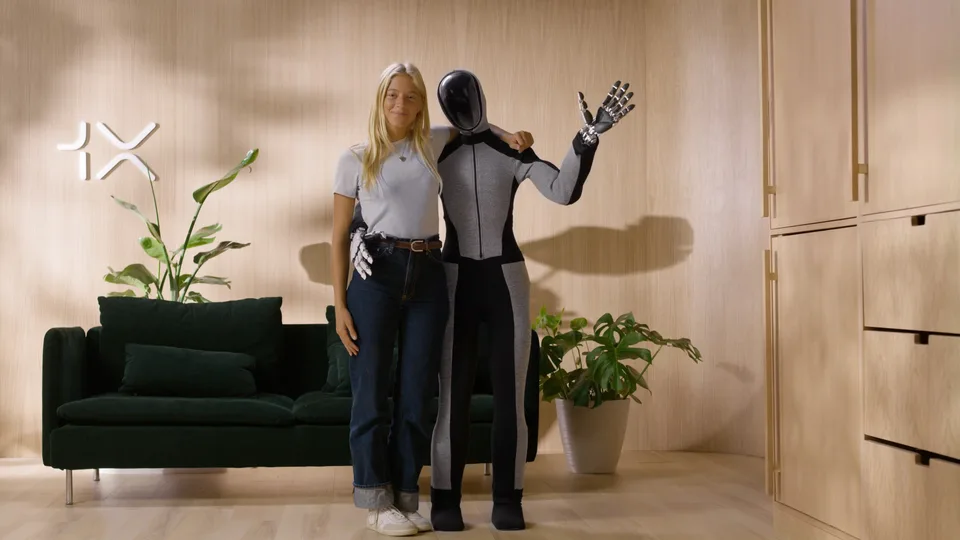
Stephen Witt’s June 29, 2026, New Yorker feature visited 1X headquarters and left with uncomfortable questions about whether NEO can deliver on its 2026 home-deployment promise. The piece documents a 5-foot-6, 66-pound robot using more than 100 motors and artificial tendons beneath a beige nylon bodysuit, with its compute board tucked in the head rather than the chest. Over 10,000 deposits have arrived at the $20,000 list price, yet every public demonstration relied on a human tele-operator in VR controlling every motion. Witt quotes 1X’s own head of product admitting that claiming zero falls remains “a total stretch.” These are not fringe concerns; they directly contradict the marketing narrative of autonomous household helpers arriving this year.
Fact and opinion must be separated here. The documented reliance on teleoperation and the explicit fall-risk admission come straight from the company during the visit. The opinion that this setup will not translate to safe unsupervised operation around children or pets belongs to multiple roboticists Witt interviewed, including Apptronik’s CEO and Google DeepMind’s robotics lead. They flag the absence of any standardized safety benchmarks for domestic environments. ZeroGantry readers have tracked tendon-actuator wear rates in industrial prototypes for years; early MTBF numbers rarely exceed a few hundred hours before cable stretch or motor fatigue appears.
Tendon-Driven Design: Elegant on Paper, Fragile in Homes
NEO’s biomimetic tendons replace rigid gearboxes in many joints, producing the quiet 22-decibel operation Witt noted. That acoustic advantage matters in living rooms, yet it introduces new failure modes. Artificial tendons stretch, fray, and require periodic tensioning—maintenance tasks that early buyers will face without factory support. The 2026 service economy will therefore hinge less on flashy demos and more on spare-part logistics and field-repair crews. Competitors using conventional rotary actuators report their own reliability curves, but none have published public domestic MTBF figures either.
Skeptics correctly note that the same tendon architecture that enables fluid motion also concentrates stress at attachment points. Witt observed decommissioned prototypes lined up like supplicants, hinting at iterative hardware revisions already underway. Scaling to thousands of units while simultaneously refining tendon durability and software autonomy creates a classic hardware-software co-design bottleneck. Production ramp announcements from 1X’s Oakland-area facility have not included third-party validation of mean time between failures under realistic household duty cycles.
Teleoperation Crutch and the Autonomy Gap
Every kitchen demo Witt witnessed required a human in VR dictating motion. 1X declined to show autonomous AI behavior. This pattern repeats across the industry: impressive videos are frequently stitched from multiple takes or assisted runs. The New Yorker piece places NEO alongside Figure 03, Boston Dynamics Atlas, and Tesla Optimus, all facing identical questions about when scripted or remotely piloted behavior yields to reliable onboard policy execution. Until that transition occurs, the $20k price tag buys a sophisticated marionette rather than a capable household member.
Carolina Parada of Google DeepMind told Witt that home deployment “comes later” precisely because safety validation lags capability. Jeff Cardenas of Apptronik echoed concerns about pets and small children. These are not abstract worries; a 66-pound machine losing balance on carpet or stairs carries real injury risk. Legal exposure for manufacturers and early adopters remains untested in court. The 2026 timeline therefore functions more as a marketing deadline than an engineering one.
Rivals Face Parallel Hurdles Amid Factory-First Strategies
Tesla’s Optimus program targets Fremont plant conversion for high-volume output, yet public demonstrations still mix autonomy with supervision. Figure 03 has logged consecutive hours alongside BMW workers in Spartanburg, South Carolina, but those deployments remain narrow-task and monitored. Boston Dynamics Atlas and Apptronik Apollo continue industrial focus, postponing consumer claims. Unitree’s G1 has shipped thousands of units, primarily to researchers and hobbyists, at lower price points, yet still exhibits the clunky locomotion and balance issues Witt observed in lab settings.
The pattern is consistent: factory or controlled-environment deployments precede any credible home rollout. Supply-chain realities reinforce this sequence. Precision actuators, high-torque motors, and custom compute boards face the same semiconductor and rare-earth constraints affecting every robotics program. Geopolitical export controls on advanced chips further complicate scaling for non-U.S. players. Labor displacement narratives in warehouses already show robots handling repetitive pick-and-place while humans manage exceptions; extending that model to chaotic home environments requires far more robust perception and recovery behaviors than current systems demonstrate.
2026 Service Economy Implications and the MTBF Reckoning
Early NEO buyers will discover that “robotics slop”—the term Witt attributes to 1X’s CEO—translates into frequent interventions. A robot that occasionally drops a bottle or requires remote rescue will generate support tickets, not passive convenience. The real 2026 market opportunity lies in maintenance contracts, tendon replacement kits, and remote-monitoring subscriptions rather than pure hardware sales. Companies that treat deployment as the finish line rather than the starting point for reliability engineering will face reputational damage when units fail in living rooms.
Witt’s reporting underscores a broader industry truth: video-ready locomotion does not equal safe, autonomous operation in unstructured spaces. The abs
Who services this hardware
Topics
Related articles
- Robotics Week in Review: Oct 2–Oct 9, 2026 — Humanoid pilots expanded in factories while AI software leaps and maintenance realities surfaced. Leadership changes and regulatory scrutiny rounded out a week
- Figure AI Melts F.02 Fleet: Schwarzenegger's Terminator Sendoff — Figure AI retired its F.02 humanoid fleet by training the robots to jump into a 75-ton electric arc furnace in Imatra, Finland. CEO Brett Adcock followed Arnold
- Robotics Week in Review: Sep 25–Oct 2, 2026 — Humanoid robots advanced toward real warehouse and factory roles while software platforms and record industrial deployments underscored automation's acceleratin
- Physical Intelligence San Francisco Lease Signals 2026 Physical AI Scaling — Physical Intelligence subleased 80,000 square feet at 850 Brannan Street in San Francisco from Airbnb in September 2026. The robotics AI firm is expanding its B